Merlin Gerin NS630 Motor Operator Wiring Checks
November 20, 2026
Compact NS630 Breaker Accessory Compatibility Checks
November 20, 2026
For a defined machinery-space view, a fixed wide-angle camera is usually the simplest and most repeatable choice. A varifocal system is better when the final camera position, required detail or viewing distance is uncertain. The decision in engine room CCTV fixed vs varifocal selection should be based on the surveillance objective first, then on lighting, installation access, compatibility and maintenance—not on lens type alone.
Start with the surveillance objective
Separate the CCTV requirement into two tasks: situational awareness and identification or inspection. A camera watching a complete engine front, purifier area or access route needs coverage and continuity. A camera intended to show a valve position, local display or leakage point needs sufficient image detail at a specific distance.
- Wide-area monitoring: choose a broad field of view when the operator must see people, access points and several items of machinery at once.
- Equipment observation: use a narrower view when one pump, gearbox, switchboard section or engine control area is the priority.
- Security coverage: consider approach routes, doors, ladders and blind spots rather than simply pointing at the largest machine.
- Evidence quality: confirm that the intended image contains enough detail for the operational decision required. A wide image may show that a person is present but not identify a small indicator or label.
Make a simple site sketch showing camera height, target distance, obstructions, lighting sources and the direction of normal personnel movement. This often reveals that two fixed cameras provide more useful coverage than one adjustable camera placed too far away.
Fixed 2.8 mm camera: strengths and limits
The Hikvision DS-2CE76D0T-EXIPF 2 MP 1080p Turret Camera, 2.8 mm, IR 20 m uses a fixed 2.8 mm lens. Its wide-angle view is suited to general area observation where the installation position has already been established. It provides 2 MP / 1080p imaging, a stated minimum illumination of 0.02 lux, digital WDR and DNR, with IR night vision up to 20 m.
Because the lens is fixed, the viewing angle does not change after installation. That is useful for a vessel maintenance team: once the camera is aligned and recorded in the inspection plan, there is no zoom ring or focus setting to disturb during routine work. It also makes replacement straightforward if the same approved model is used.
There are limitations. A 2.8 mm wide view spreads the available pixels across a larger scene. A target that occupies only a small part of the image may not show the detail required for inspection. A fixed camera also gives no commissioning adjustment if pipework, cable trays or a new enclosure later obstructs the original composition.
The product data specifies 12 V DC supply, 275 mA and 3.3 W maximum, plus switchable 4-in-1 analogue HD output: TVI, AHD, CVI or CVBS. Confirm that the recorder, power source and cable installation support the selected output mode. The supplied item is described as an indoor camera; do not assume environmental suitability for a hot, wet, oily or vibration-prone engine room without checking the equipment specification and vessel installation requirements.
Varifocal system: when adjustment has value
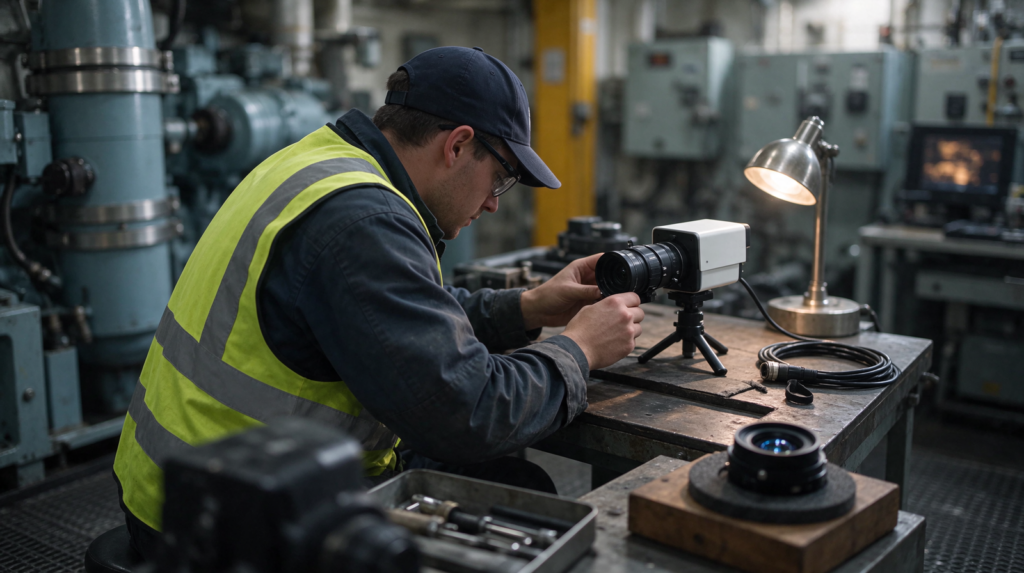
A CS-mount varifocal arrangement normally consists of a compatible box camera and a separate lens. The lens does not provide a complete CCTV system by itself. The camera, image format, mount, iris interface, supply and video output must all be compatible.
The 2.8–12 mm F1.4 Varifocal DC Auto-Iris CCTV Lens, 1/3", CS Mount provides manual focal-length and focus adjustment across 2.8–12 mm. At the short end it can provide a broad view; at the long end it gives a narrower view of a selected area. This range is useful when the camera-to-target distance is known only approximately or when commissioning staff must balance overall coverage against detail.
The lens has an F1.4 aperture and DC-drive auto-iris. The auto-iris connection allows a compatible camera to regulate the aperture as light levels change. This is different from electronic exposure compensation: the camera and lens must support the same DC auto-iris arrangement, and the lead must be connected correctly.
A varifocal lens is not automatically better in low light or at night. Its stated focal length and aperture do not establish the complete night performance of the camera. Check the camera sensor, IR compatibility, illumination pattern and recorder performance as a system. Also confirm that the selected box camera accepts a 1/3-inch CS-mount lens and provides the required DC iris drive.
Fixed versus varifocal comparison
| Consideration | Fixed 2.8 mm turret | CS-mount varifocal system |
|---|---|---|
| Commissioning | Fast alignment with no focal-length adjustment | Requires zoom and focus adjustment at the installation site |
| Coverage | Predictable wide-area view | Adjustable from broad coverage to a narrower target view |
| Detail at distance | Limited if the target occupies a small part of the frame | Can be narrowed to place more of the image on the target |
| Future layout changes | May require repositioning or replacement | Allows some reframing without changing the lens |
| Maintenance | Fewer optical adjustments to disturb | Focus, zoom, iris and compatibility require checking |
| Integration | Camera and lens are supplied as one defined assembly | Camera, lens, mount, iris drive and recorder must be matched |
Lighting, IR and image quality
Engine rooms contain difficult lighting conditions: bright work lights, deep shadows, reflective metal, steam or haze and areas that become dark when machinery is shut down. Review the image at the actual installation position during both normal operation and blackout or reduced-light conditions.
- Use WDR or equivalent dynamic-range functions carefully where bright fittings and dark machinery appear together. Excessive processing can reduce the usefulness of fine detail.
- Check whether nearby stainless steel, painted panels or glass create IR reflections. Night images should be tested at the intended angle, not only on a workbench.
- Do not treat an advertised IR distance as a guaranteed recognition distance. The fixed Hikvision camera specifies IR up to 20 m, but usable detail depends on target reflectivity, obstructions, focus and installation conditions.
- Keep the lens window clean. Oil film, salt deposits and condensation can produce glare and reduce contrast before a camera has actually failed.
For a varifocal installation, set the image at the expected lighting condition. Adjusting focus in bright light and then relying on the camera at night can expose weaknesses caused by IR illumination, aperture movement or a change in optical performance.
Installation and commissioning procedure
- Confirm the target: record the area to be observed, target distance and minimum detail required.
- Check the route: identify vibration, heat, wash-down exposure, oil mist, cable-tray access and possible obstructions.
- Verify compatibility: for a fixed camera, confirm supply voltage, current capacity, video format and recorder input. For a CS-mount system, additionally verify 1/3-inch format, CS mount and DC auto-iris compatibility.
- Isolate before electrical work: switch off and lock out the relevant supply, verify absence of voltage and follow the vessel’s permit-to-work procedure. Do not work on exposed conductors or camera power wiring while energised.
- Mount and route: use a rigid, serviceable position. Keep the camera clear of moving machinery, hot surfaces and areas where routine maintenance will strike or cover it.
- Set the view: for a fixed unit, align the turret and confirm the complete required area. For a varifocal unit, adjust focal length first, then focus, and finally verify the image through the recorder.
- Test operating conditions: check day and low-light images, switching between the selected analogue video modes where applicable, and confirm that the image remains stable during machinery operation.
- Document the result: record camera position, viewing direction, lens setting, output mode, power source and representative day/night images.
Maintenance access and viewing angles
A technically good camera can become ineffective if a technician cannot clean, realign or replace it safely. Keep access clear of hot exhaust components, rotating equipment and high-pressure cleaning streams. If access requires a ladder or work aloft, apply the vessel’s access controls and do not position the camera where routine maintenance repeatedly blocks the view.
Inspect the image rather than only checking whether the camera is online. A dirty dome or lens, shifted turret, loose bracket, water ingress or damaged cable can leave a live picture that is operationally useless. Compare the current view with the commissioning image and investigate changes in framing, focus, colour or night performance.
For varifocal systems, protect the zoom and focus rings after commissioning and record their final positions. If the image must be changed later, make the adjustment under controlled conditions and update the record. Do not assume that a replacement lens is interchangeable merely because it has the same focal-length range: verify mount, image format, iris type, camera clearance and OEM or system documentation. The CCTVSTAR SSV02812GNB 2.8–12 mm F1.4 Varifocal DC Auto-Iris Lens, 1/3", CS Mount has the same stated focal-length range and interface class as the other listed varifocal lens, but final compatibility still belongs to the camera and installation specification.
Selection checklist
- Is the priority wide-area awareness, target detail or both?
- Is the camera-to-target distance fixed and documented?
- Will the vessel layout or machinery arrangement change?
- Are the camera’s supply, video output and environmental requirements confirmed?
- For a varifocal system, are the camera’s 1/3-inch format, CS mount and DC auto-iris support confirmed?
- Has the image been tested with actual engine-room lighting and IR conditions?
- Can technicians safely reach the camera for cleaning and alignment?
- Are the exact part number and any supersession verified against the vessel or OEM documentation?
In practical terms, select a fixed 2.8 mm turret when the required wide view is known and low-complexity maintenance is important. Select a CS-mount varifocal system when commissioning adjustment or closer observation of a defined target justifies the additional compatibility and setup work.
FAQ
Is a 2.8 mm camera suitable for every engine-room view?
No. It is useful for broad coverage, but a distant or small target may not contain enough image detail. Confirm the target size and distance before selecting it.
Can any CS-mount camera use a 2.8–12 mm lens?
No. Verify the camera’s image format, CS mount, DC auto-iris support, connector arrangement and optical clearance before installation.
Does varifocal mean motorised zoom?
No. The listed varifocal lenses use manual zoom and focus rings. Adjustment is made during installation; motorised control is not specified.
Should IR range be used as the detection distance?
No. IR range is an equipment specification, not a guaranteed recognition distance. Test the complete camera, lens, recorder and scene under actual low-light conditions.